

Engineers evaluating BEAM often start with the wrong question:
Is BEAM faster than the runtime I already know?
It is a reasonable question, but it frames the problem the wrong way.
BEAM was not designed to win every benchmark. Its roots are in Erlang, a language created for telecom systems where downtime was unacceptable. That history shaped a runtime built around a different problem: keeping many concurrent, stateful, independent activities running when parts of the system fail.

That is the key to understanding Erlang, Elixir, and OTP. The ecosystem is built around a specific view of software: systems fail, networks fail, dependencies fail, processes get into bad states, and production does not care about your clean abstraction boundaries.
The answer is not to prevent every failure. It is to make failure contained, observable, and recoverable.
So the better evaluation question is:
Does my system need to manage many long-lived activities that own state, communicate, fail, and recover independently?
If the answer is yes, BEAM deserves serious consideration.
The constraints explain the runtime
A useful way to understand the runtime is to look at the constraints it optimizes for.
BEAM assumes your system may need many concurrent activities, long-lived stateful processes, isolation between components, failure containment, recovery without restarting the whole system, soft real-time responsiveness, runtime observability, distributed communication, and operational continuity.
Those constraints explain the design choices: processes must be cheap, memory should be isolated, failures need to be observable, recovery needs to be explicit, and scheduling must prevent one process from monopolizing the system.
The design is coherent because these choices reinforce each other. Lightweight processes, message passing, supervision, per-process memory, and observability are not isolated features. They are different answers to the same core constraint: preserving service continuity under concurrency and failure.
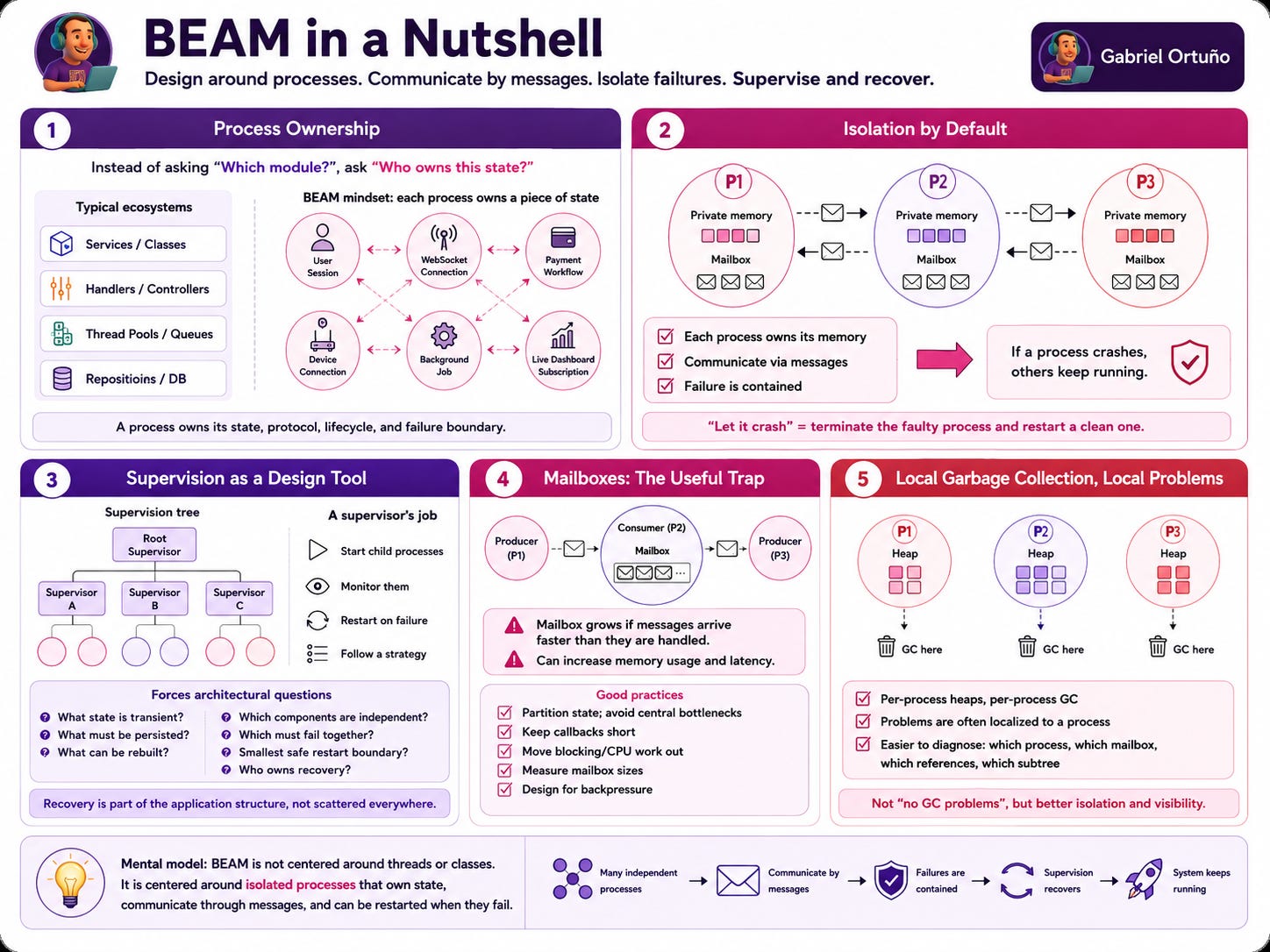
BEAM’s basic unit of architecture is not a thread, a class, or a request handler. It is an isolated process that owns state, communicates through messages, and can be restarted when it fails.
The core design: process ownership
The most important architectural shift is process ownership.
In many ecosystems, engineers design around classes, modules, services, handlers, queues, repositories, and thread pools. In Erlang and Elixir systems, you also design around processes.
A process is a lightweight runtime-managed unit of execution. It is not an operating system process. It has its own memory, its own mailbox, and its own lifecycle. Processes communicate by sending messages.
This changes the way you model a system.
Instead of asking only:
Which module should contain this logic?
You ask:
Who owns this state?
This question is fundamental.
A process can own a user session, a WebSocket connection, a payment workflow, a device connection, a background job, or a live dashboard subscription. It can even own the state of a single moving car on a live map. This is not just implementation detail. It becomes architecture.
I have seen this most clearly in real-time operational tools built with Phoenix LiveView. The hard part was not rendering one screen or processing one request quickly. The interesting part was coordinating operational state, user interactions, real-time updates, and long-lived activities safely. When each moving entity can be modeled independently, BEAM’s process model becomes a very natural fit.
A process is not merely a concurrent task. It is often the owner of a piece of state, a protocol, a lifecycle, and a failure boundary.
This is one of the strongest reasons to consider BEAM: runtime boundaries can align naturally with domain boundaries.
Isolation by default
Processes do not share memory in the normal way. They communicate through messages.
A process owns its memory. Other processes cannot casually mutate it. To interact, they send messages.
The benefit is significant: failure and state are easier to contain.
In a BEAM system, one process getting into a bad state does not necessarily corrupt the rest of the system. It can crash. A supervisor can restart it. Other processes can continue.
This is the foundation of “let it crash”.
The phrase is often misunderstood. It does not mean “write careless code”. It means accepting that sometimes the safest recovery strategy is to terminate a faulty process and restart a clean one.
This only works when failure boundaries are small. BEAM gives you those boundaries.
Supervision as a design tool
In many systems, error handling is local: a function returns an error, a method throws an exception, a task fails, or infrastructure restarts the whole process.
OTP adds another layer: supervision.
A supervisor is a process whose job is to start, monitor, and restart child processes according to a strategy. The strategy defines what happens when a child fails. Should only that process restart? Should all related processes restart? How many restarts are acceptable before escalating?
This is not just a library convenience. It is a system design tool.
A supervision tree describes the failure topology of your application. It forces architectural questions that many systems postpone:
What state is transient?
What state must be persisted?
What can be rebuilt?
Which components are independent?
Which components must fail together?
What is the smallest safe restart boundary?
Who owns recovery?
In a well-designed BEAM system, recovery is not scattered randomly across `try/catch`, retries, callbacks, and infrastructure probes. Recovery is part of the application structure.
For long-running systems, this is a serious advantage.
Mailboxes as the communication model
Every BEAM process has a mailbox. Other processes send messages to it. The receiving process chooses when and how to handle them.
This gives you a clean model for asynchronous communication. It also enables selective receive, where a process can wait for messages matching a certain pattern while leaving other messages in the mailbox.
Mailboxes make process communication explicit. Instead of shared mutable state, processes exchange messages and react to them.
This reinforces the broader model: state is owned locally, communication is explicit, and each process has a clear boundary.
Per-process garbage collection
One of the runtime’s most important choices is per-process garbage collection.
Each process has its own heap. Garbage collection usually happens per process.
As a result, a process with a small heap can be collected quickly. A process that allocates heavily pays much of its own cost. Other processes can often continue running.
This fits the broader philosophy: isolate not only state and failure, but also memory management cost.
For highly concurrent systems with many small independent processes, this can reduce latency coupling between unrelated activities.
It also gives engineers a more concrete debugging model. Instead of asking only:
Why is memory growing?
You can ask:
Which process owns this memory?
That is a much more useful operational question.
When BEAM is the right fit and when it is not
No runtime is a universal answer, and BEAM is no exception.
BEAM is especially attractive when the domain naturally contains many independent concurrent entities: real-time communication, chat, presence, collaborative applications, live dashboards, IoT device management, game servers, workflow orchestration, background jobs, WebSocket-heavy applications, event-driven state machines, and long-lived business processes.
In these systems, the hard part is often not one request. The hard part is lifecycle.
Something starts. It receives events. It owns state. It waits. It times out. It talks to other components. It may fail. It may need to restart. It may need to recover state. It may need to notify others.
This is where BEAM’s process model shines.
A useful heuristic:
If your architecture diagram has many boxes representing independent things that live over time, BEAM is worth evaluating.
The opposite is also true. If your architecture diagram is mostly stateless request/response handlers plus database calls, BEAM can still work well, especially with Phoenix, but its unique runtime advantages may matter less.
Be more cautious if your core workload is CPU-heavy computation, machine learning inference, large-scale numerical processing, video/audio processing, high-performance compression or encryption, large mutable in-memory data structures, low-level systems programming, ultra-low-latency trading-style systems, or workloads dominated by SIMD/vectorization.
Also be careful if the key libraries are much stronger outside the BEAM ecosystem, or if the team has no appetite to learn OTP deeply.
BEAM can still participate in those systems. It can coordinate them, supervise them, expose APIs around them, and manage long-running workflows. But it is often not the best place to run the hottest CPU loop.
A mature BEAM architecture often uses BEAM for orchestration and resilience, while delegating specialized computation to external services, ports, or carefully controlled native code.
This is not a failure. It is good architecture.
The traps newcomers underestimate
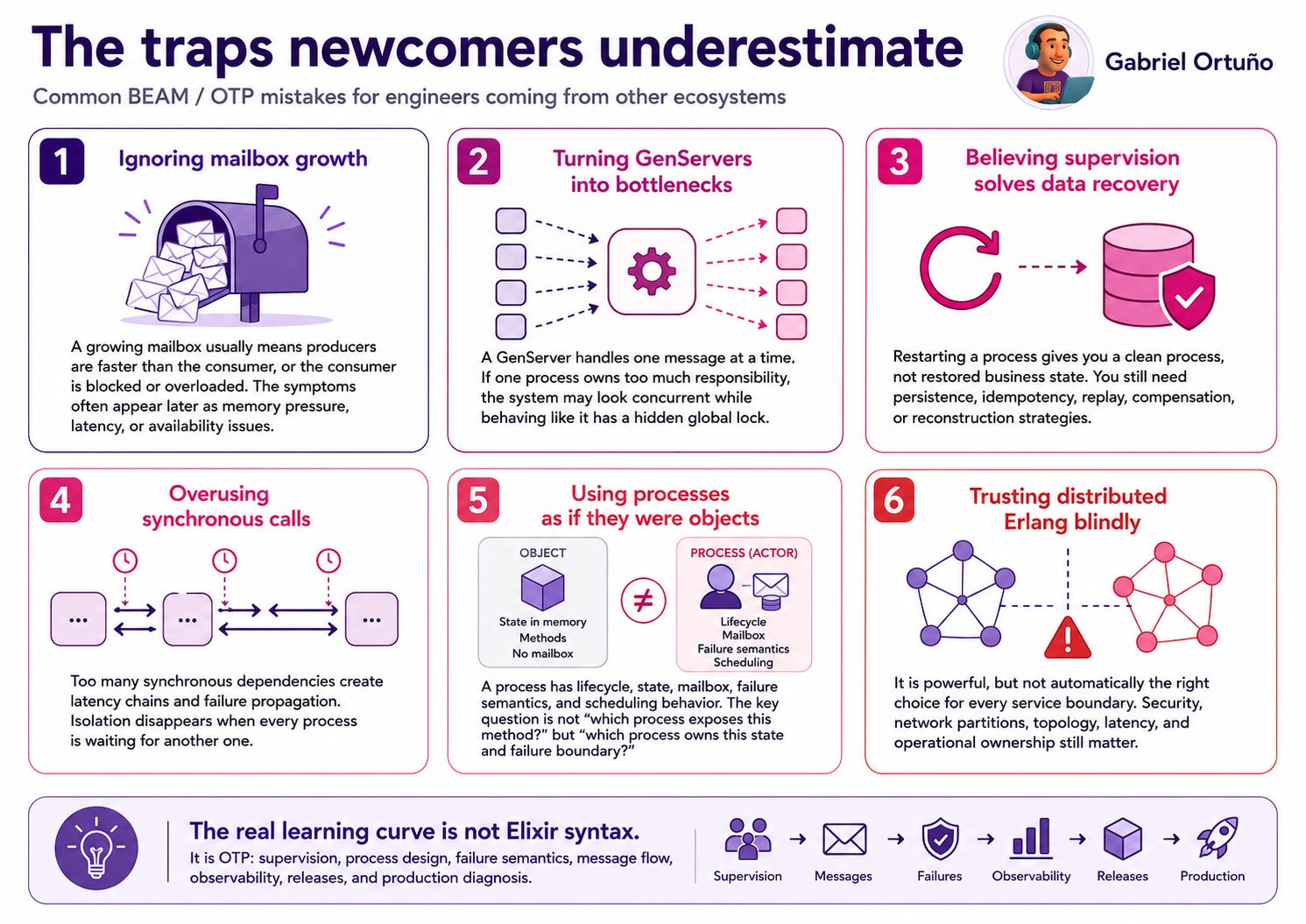
A few traps are especially common for engineers coming from other ecosystems. They are not syntax problems. They are runtime-model problems.
The most important one is ignoring mailbox growth. A growing mailbox usually means producers are faster than the consumer, or the consumer is blocked or overloaded. If you do not monitor mailboxes, the problem may only become visible through memory pressure, latency, or availability issues.
The second trap is turning `GenServer`s into bottlenecks. A `GenServer` processes one message at a time. If you put too much responsibility into one process, the system may look concurrent while behaving like it has a hidden global lock.
The third trap is believing supervision solves data recovery. Restarting a process gives you a clean process, not restored business state. You still need persistence, idempotency, replay, compensation, or reconstruction strategies.
The fourth trap is overusing synchronous calls. `GenServer.call` is useful, but too many synchronous dependencies create latency chains and failure propagation. Isolation disappears when every process is waiting for another one.
The fifth trap is using processes as if they were objects. A process has lifecycle, state, mailbox, failure semantics, and scheduling behavior. The better question is not “which process exposes this method?”, but “which process owns this state and failure boundary?”
The sixth trap is trusting distributed Erlang blindly. It is powerful, but it is not automatically the right choice for every service boundary. Security, network partitions, topology, latency, and operational ownership matter.
The real learning curve is not Elixir syntax. The real learning curve is OTP: supervision, process design, failure semantics, message flow, observability, releases, and production diagnosis.
Final recommendation
Do not evaluate BEAM as a drop-in replacement for your current runtime. Evaluate it as a different way to structure a system.
Before choosing it for a real project, run a small architectural spike around the runtime model, not just around syntax or framework productivity.
Model one meaningful part of your domain as processes:
What owns the state?
What messages cross the boundaries?
What happens when one process crashes?
What state must be rebuilt or persisted?
What can be supervised safely?
What happens if messages arrive faster than they are consumed?
Where does CPU-heavy work belong?
If that exercise makes the design clearer, BEAM may be a strong fit.
If it makes the design feel artificial, or most of the value still lives in request handlers, database queries, and external libraries, another runtime may be a better default.
That is the practical test.
BEAM earns its place when process ownership, isolation, supervision, and recovery make the system easier to reason about — not merely because Elixir is pleasant or the runtime is elegant.
Further reading
These are good starting points if you want to go deeper into BEAM, Erlang/OTP, and the runtime ideas behind this article:
A brief introduction to BEAM — official Erlang/OTP primer on what BEAM is and how it relates to the Erlang Runtime System.
The BEAM Book — a deep technical reference on BEAM internals, instructions, scheduling, memory, and runtime implementation details.
Erlang in Anger — Fred Hébert’s practical guide to operating and debugging Erlang systems in production.
Erlang/OTP Design Principles — official documentation on OTP behaviours, supervision trees, applications, and releases.
Supervisor behaviour documentation — official reference for OTP supervisors and restart strategies.
Erlang Efficiency Guide — official guidance on processes, memory, binaries, and performance trade-offs.